Conférence
22 janvier 2026 - de 11h30 à 13h00
Insights into Beneficial Ownership and Economic Crime
Conférence-midi en anglais
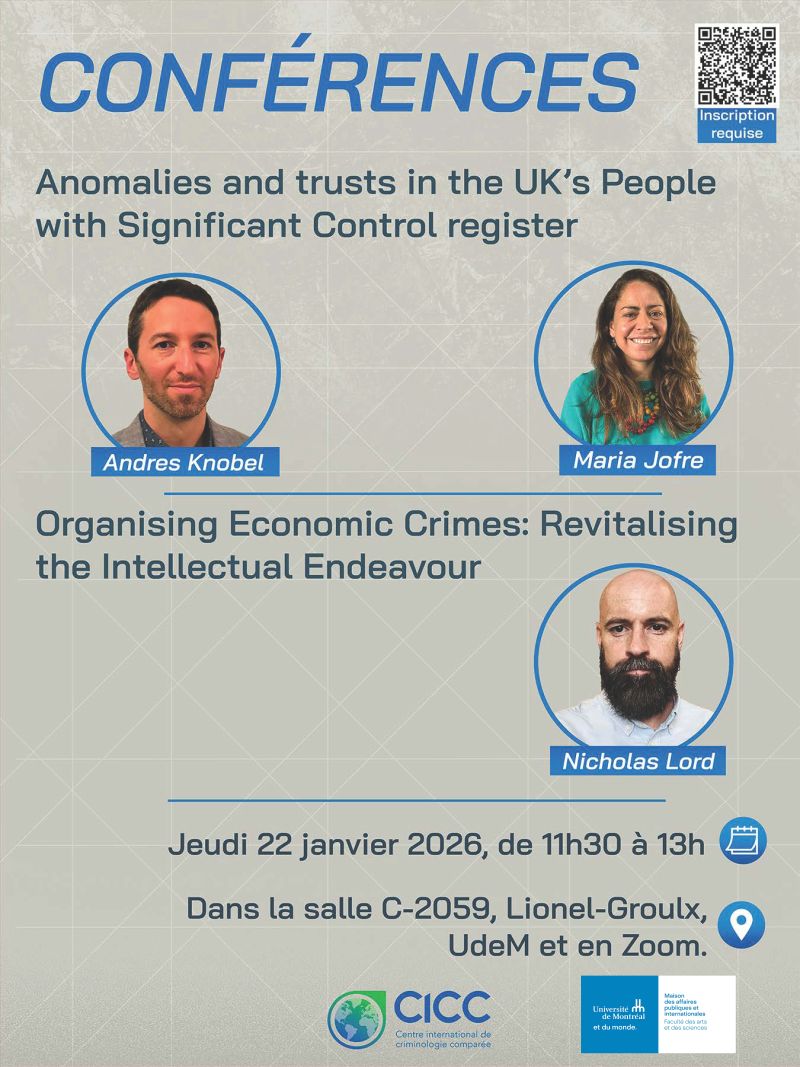
Conférences de Maria Jofre, Andres Knobel et Nicholas Lord.
Jeudi 22 janvier 2026, de 11h30 à 13h.
Dans la salle C-2059, Lionel-Groulx, UdeM et en Zoom.
Cet événement est organisé en collaboration avec la Maison des affaires publiques et internationales.
(Après votre inscription au zoom, un courriel de confirmation vous permettra d’ajouter cet événement à votre calendrier.)
11:30 AM - 12:15 PM
Anomalies and trusts in the UK’s People with Significant Control register

Speakers:
Maria Jofre, Data Analysis and Insights Lead, Open Ownership
Andres Knobel, Lead Researcher Beneficial Ownership, Tax Justice Network
Abstract:
This research examines how structured beneficial ownership (BO) data can be used to uncover hidden ownership patterns and inform anti-money laundering (AML) efforts. Using the United Kingdom’s (UK) People with Significant Control (PSC) register, the study applies a two-stage analytical approach: first, to detect anomalous reporting patterns; and second, to analyse trust-related declarations. While trusts are widely acknowledged as high-risk vehicles for money laundering, systematic research on how they are reflected in BO data of legal entities remains limited. The study finds that entities without declared individuals, with inconsistent interest configurations, and with indirect control through trusts can all be detected using publicly available data. Trust-related interests, though representing only a small share of disclosures, appear in some of the largest and most opaque ownership networks. However, the lack of integration between the UK’s BO, shareholder, and trust registers restricts the ability to identify all parties involved and map complete ownership chains. Closing these gaps – through improved interoperability and data sharing – would significantly strengthen oversight capabilities and enhance the effectiveness of AML risk assessments.
12:15 PM - 13:00 PM
Organising Economic Crimes: Revitalising the Intellectual Endeavour
Speaker:
Nicholas Lord, Professor of Criminology, The University of Manchester
Abstract:
This talk, based on my recent book entitled Organising White-Collar and Corporate Crimes, 2025, Routledge, co-authored with Mike Levi) explores how we can re-constitute our approach to analysing and empirically investigating the organisation of economic crimes, with a view to building fuller theoretical and empirical accounts. If we aspire to better understand, and respond to, ‘economic crimes’ (however defined), systematic consideration of their organisation must be central to the scholarly, practice and policy discussion. All economic crimes require some level of organisation: the subjective recognition of objective criminal opportunities, and the appreciation of how to make the most of them; the particular procedural requirements of the individual ‘economic crime scripts’ and the conditions amenable to these; the network of collaborators and facilitators who are necessary to accomplishing some activities; the post-activity management of the proceeds or concealment of the crime, and so on. Understanding (1) how such crimes are organised, (2) why they are organised as they are and who gets involved in them, as primary offenders and as facilitators, and (3) the ‘real’ factors that shape these organisational dynamics over time within particular contexts and under varying conditions is key to building more comprehensive explanations and to developing more plausible and long-lasting regulatory strategies and interventions. The talk will present a framework for embracing the complexity of economic crime commissioning, offering a route to building concrete theoretical insights.