


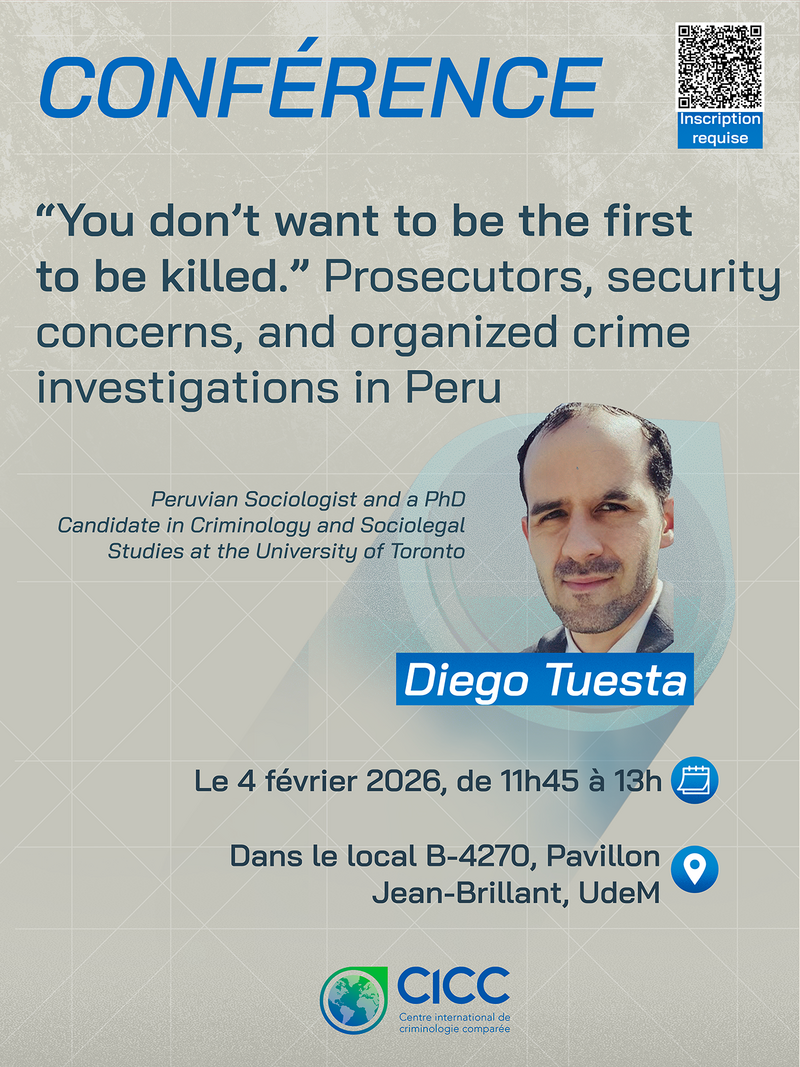
Conférence de Diego Tuesta.
Mercredi 4 février 2026, de 11h45 à 13h.
Dans la salle B-4270, Jean-Brillant, UdeM et en Zoom.
Inscription pour les places en présentiel.
(Après votre inscription, un courriel de confirmation vous permettra d’ajouter cet événement à votre calendrier.)
When criminologists talk about security, they generally do so in relation to policing and public safety. But what about prosecutors? In various countries, particularly under the civil law tradition, prosecutors conduct criminal investigations and face dangers ranging from intimidation to death threats. Drawing on 34 interviews with prosecutors who handle organized crime cases in Peru, I argue that security is a paramount focal concern for these actors, since safety threats often undermine their investigations and shape their experiences within and outside the courtroom. Research on prosecutorial safety is scant, notwithstanding occasional high-profile cases and depictions in popular culture. I address this gap and demonstrate how threats of physical harm and unlawful interference—including infiltration and sabotage—compromise investigative efforts and structure the everyday lives of prosecutors. The study makes two contributions to criminology. First, it expands focal concerns theory beyond the U.S. and its focus on judicial disparities. Second, it integrates focal concerns theory within a framework (the sociology of testing) that refines our understanding of prosecutorial discretion and opens space for cross-national comparisons.

Diego Tuesta is a Peruvian Sociologist and a PhD Candidate in Criminology and Sociolegal Studies at the University of Toronto. His research areas include the sociology of punishment, prosecution studies, organized crime and human trafficking. His PhD dissertation is a multi-study on prosecutorial discretion in Peru in the context of human trafficking, environmental protests, and organized crime. His research has been featured in criminology outlets such as the British Journal of Criminology and Punishment and Society.
Attention - Votre version d'Internet Explorer est vieille de 21 ans et peut ne pas vous offrir une expérience optimale sur le site du CICC. Veuillez mettre à jour votre ordinateur pour une expérience optimale. Nous vous recommandons Firefox ou Chrome, ou encore ChromeFrame si vous êtes dans un environnement corporatif ou académique dans lequel vous ne pouvez pas mettre à jour Internet Explorer.