


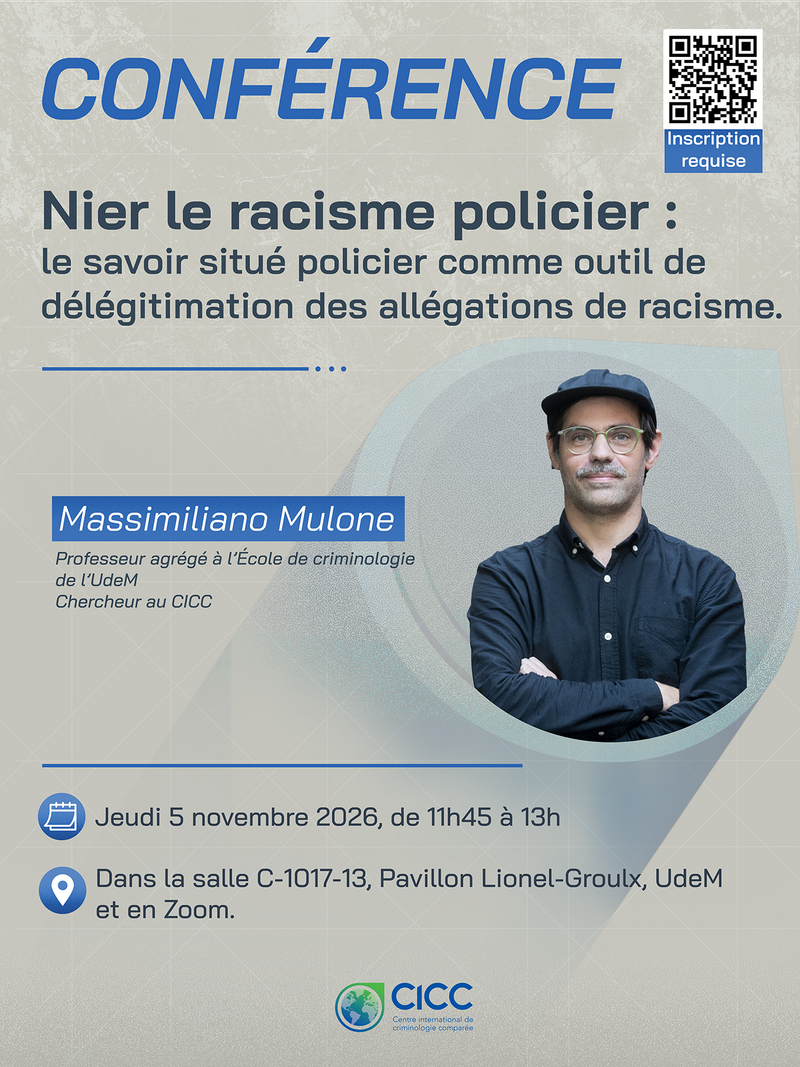
Conference by Massimiliano Mulone
Thursday, November 5, 2026, from 11:45 a.m. to 1:00 p.m.
Room C-1017-13, Pavillon Lionel-Groulx, Université de Montréal, and via Zoom
Registration required for in-person attendance
Registration required for Zoom
For more than 10 years, Canadian municipal authorities have required their police services to provide independent researchers with access to internal data in order to document and measure racial discrimination in certain police practices, including street checks, traffic stops, and use of force. The findings emerging from these studies, which have examined hundreds of thousands of police interactions over nearly 20 years, are unequivocal: certain racialized groups, particularly Black, Arab, and Indigenous people, are disproportionately targeted by law enforcement agencies across the country.
Yet, despite this growing body of empirical evidence, law enforcement agencies continue, for the most part, to adopt a position of denial and to challenge allegations of racism within their profession.
Drawing on a cross-analysis of nearly 2,000 newspaper articles published in Quebec between 2006 and 2025, as well as 103 interviews conducted with police officers in Quebec, this presentation seeks to shed light on the various discursive processes through which this denial takes shape. By identifying the main discursive strategies used by law enforcement in the public sphere and analyzing police rationalizations of disparities in treatment documented by research, I will examine how police officers’ experiential knowledge is mobilized to produce doubt and delegitimize allegations directed at their profession. This analysis will draw in particular on the concepts of the hierarchy of credibility and epistemic injustice and, more broadly, will be situated within the field of the epistemology of ignorance.
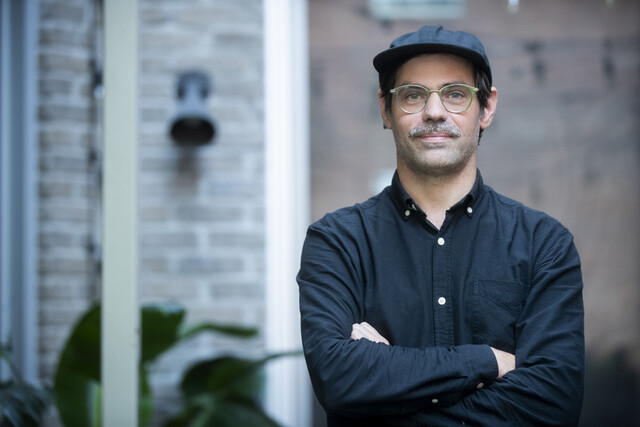
Massimiliano Mulone
Associate Professor at the School of Criminology, Université de Montréal. Specializing in policing and security issues, his current research focuses in particular on police deviance and its control—and, more broadly, on the analysis of systems designed to control police deviance—as well as racial profiling and street-check practices within policing.
He also studies the commodification of security and the ways in which policing is increasingly being privatized, both nationally and internationally. The private security industry, the commercialization of police services, and private military companies are among his areas of research interest.
Attention - Votre version d'Internet Explorer est vieille de 21 ans et peut ne pas vous offrir une expérience optimale sur le site du CICC. Veuillez mettre à jour votre ordinateur pour une expérience optimale. Nous vous recommandons Firefox ou Chrome, ou encore ChromeFrame si vous êtes dans un environnement corporatif ou académique dans lequel vous ne pouvez pas mettre à jour Internet Explorer.