


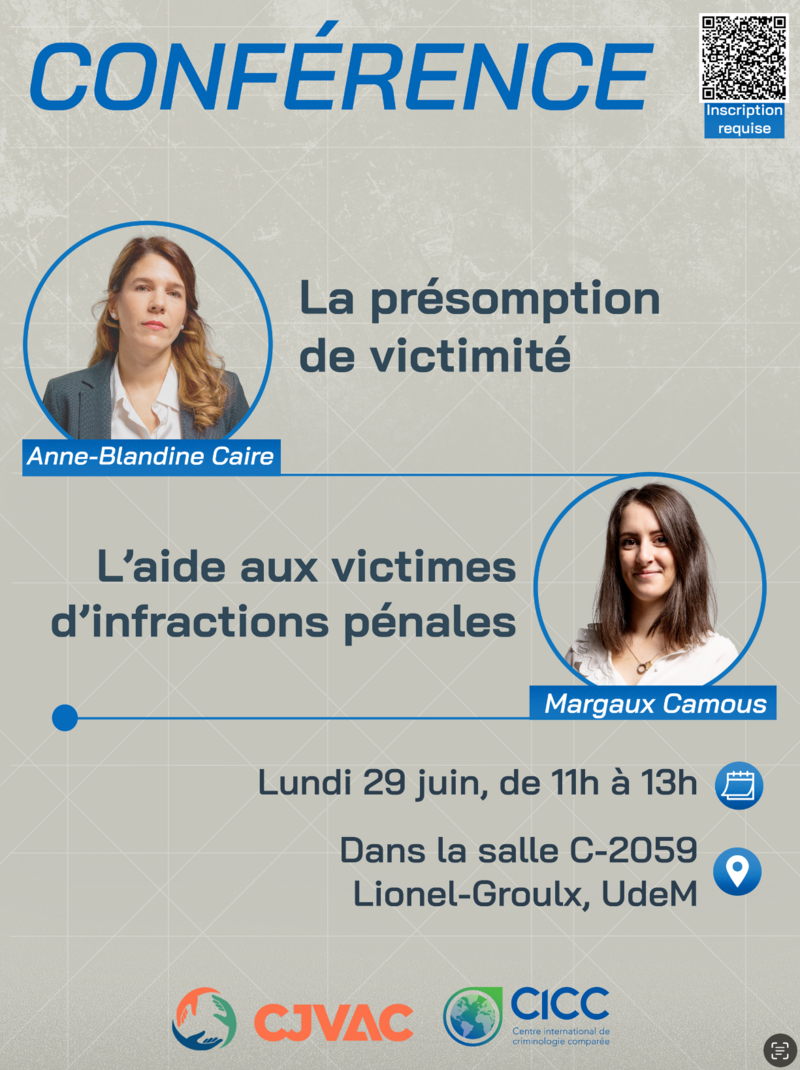
Lectures by Margaux Camous and Anne-Blandine Caire
Monday, June 29, 2026, 11:00 a.m. – 1:00 p.m.
Room C-2059, Lionel-Groulx Building, Université de Montréal
The presumption of innocence constitutes one of the fundamental guarantees of criminal proceedings. Yet, the place afforded to victims is often conceptualized in opposition to this requirement. As a result, any enhancement of victims’ rights may appear liable to undermine the rights of the defence.
This presentation examines the concept of the “presumption of victimhood.” Rather than establishing a presumption of guilt or a presumption as to the truthfulness of allegations, this notion invites reflection on how institutions receive and treat individuals who present themselves as victims before the facts have been established.
Drawing on scholarship on secondary victimization, the argument advanced is that the protection of victims and the protection of defendants are not necessarily antagonistic. On the contrary, the presumption of victimhood may be understood as a condition of procedural fairness, helping to prevent the harmful effects of systematic suspicion while fully preserving the requirements of the presumption of innocence.
This perspective ultimately calls for a rethinking of the relationships between truth, protection, and justice in contemporary criminal proceedings.

Anne-Blandine Caire is a Professor of Private Law and Criminal Sciences at Université Clermont Auvergne. A specialist in criminology, victimology, and legal theory, her research focuses on legal presumptions, fundamental rights, and contemporary transformations of criminal justice. She is notably the author of the concept of the “presumption of victimhood,” developed through her work on secondary victimization and the recognition of victims within criminal proceedings.
This research proposes a theoretical framework for victim support in French law, highlighting the distinctive features of its implementation. The evolution of its legal regime has been shaped in particular by European Union law and by the case law of the European Court of Human Rights, both of which now place victims at the centre of the criminal justice response. Improving the support provided to victims also requires a stronger integration of insights from victimology, both in academic teaching and professional training, as well as in the practical delivery of victim assistance.

Margaux Camous holds a Master’s degree in Judicial Careers from Université Clermont Auvergne. She completed her doctoral research between 2020 and 2026 under the supervision of Professor Anne-Blandine Caire. Her work has included research conducted within a victim support organization, as well as two years of university-level teaching.
Attention - Votre version d'Internet Explorer est vieille de 21 ans et peut ne pas vous offrir une expérience optimale sur le site du CICC. Veuillez mettre à jour votre ordinateur pour une expérience optimale. Nous vous recommandons Firefox ou Chrome, ou encore ChromeFrame si vous êtes dans un environnement corporatif ou académique dans lequel vous ne pouvez pas mettre à jour Internet Explorer.